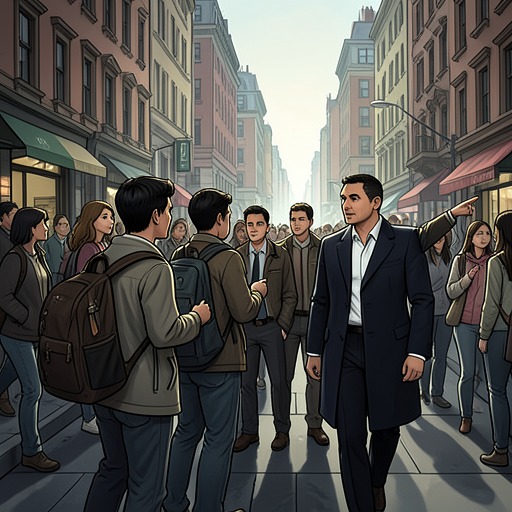
West Side Story
I'd Like to Apologize to Every Teacher I Ever HadWest Side Story matters in the book not simply as a Broadway attraction but as a bridge between a canonical Shakespearean text, the students’ own understanding of neighborhood conflict, and an unfamiliar world of theatrical possibility. Tony Danza presents the musical as a work his class can enter through what they already know, then watches the students’ excitement, recognition, and shock transform a field trip into a lesson about art, violence, love, and access.
Adaptation and Classroom Preparation
Tony Danza introduces West Side Story through the class’s existing Shakespeare study. He describes it as a Shakespeare to Street version of Romeo and Juliet, using the class’s own Shakespeare to Street activity to make the comparison immediate. The setting shifts to New York City’s Upper West Side in the 1950s; the lovers become Tony and Maria; and the Montagues and Capulets become the rival gangs the Jets and the Sharks. Tony belongs to the white Jets, while Maria is Puerto Rican and connected to the Sharks through her brother. The adaptation therefore preserves the structure of star-crossed love while relocating its conflict into modern urban gang rivalry.
The students immediately test the comparison by asking whether Tony and Maria die as Romeo and Juliet do. Tony refuses to reveal the ending, protecting the play’s suspense rather than reducing the lesson to a plot explanation. He then conducts a quick review of Romeo and Juliet and works to build anticipation for the performance. The preparation has unusual force because none of the students has ever attended a Broadway show. For Tony, the coming experience includes the first thrill of the overture and the moment when the stage comes alive; for the students, it promises entry into a cultural institution that has previously been outside their experience.
The Broadway Field Trip
When Tony announces that approval has been secured from both the television network and the school, the classroom erupts. The students dance, high-five, and hug one another, reacting as if they had won the lottery. The trip is designed as more than a theater visit: the class will travel by bus to New York City, attend a Broadway matinee, and eat afterward at Patsy’s, the Italian restaurant owned by Tony’s friend Sal. Their questions about the food, the Empire State Building, and whether they can see where Tony lives show how the excursion expands into a larger fantasy of the city and of their teacher’s life.
The trip also requires an expanded adult structure. Fred, the driver who showed the group around Washington, D.C., is brought back, while Joe Connelly, Assistant Principal McCloskey, and Ms. Smotries, a special education teacher experienced with problem students, join the chaperone team. The group becomes large enough to cover two trips. This practical detail underscores the tension between cultural opportunity and institutional responsibility: the students are being offered an extraordinary experience, but moving them safely through a major city demands vigilance, supervision, and considerable adult labor.
At the Palace Theatre, the students sit in the second balcony, but the distance does not prevent the building from impressing them. The theater is described through its polished brass and gold leaf, red velvet curtain, plush carpet, and charged preshow atmosphere. An usher recognizes Tony from his Broadway role as Max Bialystock in The Producers and tells the students that their teacher was the star of the show. Katerina asks whether Tony performed in a theater like this one, and he confirms that he once appeared in a major Broadway musical just before the lights go down. The moment connects Tony’s public identity as an actor with his new identity as a teacher, while allowing the students to see him through the eyes of the theatrical world.
Recognition, Violence, and Audience Response
The production initially presents gang members who do not resemble the students’ familiar street culture. The Jets and Sharks lack dreadlocks, rags, saggy pants, ball caps, and tattoos. Yet the visual distance does not block identification. The students recognize the emotional core of the love story, and the music and dancing quickly absorb them. When Tony is shot at the end, half the students scream and leap from their seats. Their reaction converts the performance from an abstract cultural artifact into a physically felt encounter with loss.
That response also complicates the classroom analogy. West Side Story translates Romeo and Juliet’s inherited family feud into racialized and neighborhood-based gang conflict, but the musical’s older theatrical codes do not perfectly reproduce the students’ lives. The students can notice the period style and the unfamiliar appearance of the gangs while still responding to the central experience of forbidden attachment and sudden violence. The adaptation works precisely through that double movement: it is distant enough to be art, yet close enough to make the stakes recognizable.
The walk afterward intensifies the contrast between theatrical representation and urban reality. The group emerges into Times Square after dark and must cross nine crowded blocks to Patsy’s. Sidewalk salesmen press flyers for girlie shows into the boys’ hands, merchants try to draw the girls into souvenir shops, and a homeless person asks the students for money while claiming it is for college tuition. Several students give him change before Tony can pull them away. The field trip thus moves from the controlled violence of the Palace Theatre into an uncontrolled public environment where the adults must keep the group together and protect the students from exploitation, distraction, and danger.
Cultural and Thematic Significance
West Side Story becomes part of Tony’s larger attempt to make canonical literature legible without treating his students’ culture as an obstacle. The musical gives the class a concrete way to revisit Romeo and Juliet, but it also demonstrates that adaptation can travel in both directions: Shakespeare is brought toward the street, while the students are invited toward Broadway. Their excitement suggests that access to high-profile cultural spaces can alter what they imagine education to include.
The performance also extends the book’s recurring concern with social justice and unequal opportunity. Tony’s curriculum repeatedly returns to the question of what happens when people are denied a fair chance to succeed, and West Side Story gives that concern a public, musical form through racial division, territorial conflict, and the destructive consequences imposed on young people. The students’ immediate emotional response shows that the subject does not remain safely historical. The musical lets them recognize conflict without requiring the production to duplicate their exact world.
Its deepest function is therefore connective. West Side Story links Shakespearean tragedy to contemporary student experience, Tony’s acting past to his teaching present, and classroom preparation to lived cultural participation. The students leave the theater not merely having seen a famous show but having encountered a version of their own concerns—love, loyalty, rivalry, identity, and violence—reframed in a place they had never before entered.